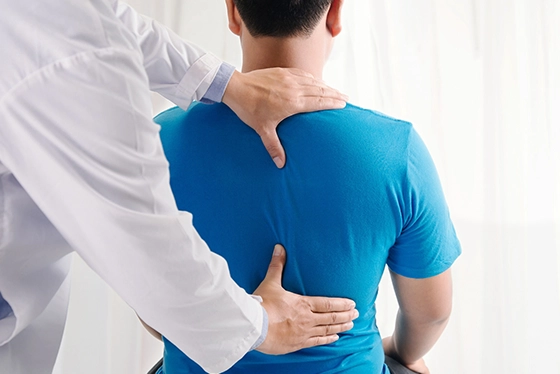
The most common reasons for back pain are mechanical problems with the facet joints of the spine, followed by problems with the mechanics of the S-I joints and pelvis. This is the bread and butter of chiropractic treatment and by the time people find me they have often pursued chiropractic intervention. I treat the spine and pelvis for sure, but I am often seeing people for whom treatment of the spine was inadequate for bringing symptoms under control.
Other areas that need to be considered include:
Thee rib cage.
Ribs have multiple patterns of dysfunction. They can be stuck in inhalation or exhalation, they can be pushed anteriorly or posteriorly, they can be compressed from front to back or from the side. They can be stuck to the lung after viral or bacterial pneumonia (including Covid). There are complex dysfunctions of the spine that involve the vertebral segment being injured on more than one occasion which can lock the rib head in place. The rib cage can be influenced by fascial structures that support the heart and great vessels. Ribs 6-12 all have attachments to the diaphragm. If it’s being influenced by some other source it can influence the rib motion potentially causing or contributing to back pain.
In the abdomen there are also organs that have attachments to the spine that can hamper normal movement and lead to back pain. The liver and kidneys are the most involved organs but the spleen, pancreas, blood vessels that supply the small and large intestine as well as the liver, spleen, duodenum and pancreas can all be involved in back pain. Solid organs can shift in position because of the sudden starts and stops associated with falls and MVA’s. Guiding them back into position can be critical for some people’s back pain.
Discs get blamed for a lot of back pain and if they are the underlying cause of pain there are limited things an osteopath can do to help. The nutrition to discs is influenced by motion. The disc has limited circulation. Its nutrition comes more from sponge like squeezing out waste products and absorbing nutrients. When the facets are locked this motion is compromised and over time the disc may break down. Prolonged loss of motion leads to adjacent spinal segments needing to create more available movement and over time the associated disc takes more of a beating, and the segment can become hypermobile potentially becoming painful. The osteopathic approach is to make sure that nearby joints are moving as well as possible decreasing the forces contributing to hyper mobility. Having degenerative discs is part of aging. Findings of degenerative disc disease, sometimes even frank disc herniation on an MRI scan can be totally asymptomatic. It is important to treat the body and not the scan.
My final consideration for back pain as I write this, is the potential of surgical scars to impact back pain. Scars develop over time and visceral scars can have tendrils that attach to organs as well as fascia associated with the spine, pelvis and lower back muscles. Scars don’t go away with osteopathic treatment, but their impact can be managed and motion can usually be at least partially restored leading to reduced symptoms. An osteopath helps restore anatomic function but cannot reverse anatomic changes to scars, joints, or discs.